Automate Your Content Workflow: The Power of AI Content Editing

INTRODUCTION

The blank page isn't your content team's biggest enemy anymore. Your real challenge? The crushing weight of manual coordination that follows every piece of content you create. Publishing managers across e-commerce and media companies face an identical reality: scaling content output while maintaining quality demands endless approval cycles, perfect cross-channel coordination, and an ever-growing army of editors just to keep pace.
Picture this scenario: your team publishes 500 product descriptions monthly. Each piece needs SEO optimization, brand voice alignment, compliance checks, and channel-specific formatting. Without AI content workflow automation, that creates 500 separate opportunities for bottlenecks, missed deadlines, and inconsistent quality. Your strategic minds spend more time managing tasks than creating value.
**AI content workflow automation** transforms this operational chaos into orchestrated efficiency. Modern AI systems integrate directly into your editorial operations, automatically scheduling reviews, coordinating cross-channel publishing, and maintaining quality standards through intelligent checkpoints. This isn't about replacing human creativity—it's about freeing your team from repetitive coordination work that burns out talent and slows growth.
The technology has reached a critical inflection point. Publishing teams can now deploy AI that learns their specific brand voice, automates first-pass editing, and coordinates complex approval workflows across multiple stakeholders. Your content moves from draft to publication with minimal manual intervention while quality controls ensure every piece meets your standards.
Your competitors are already implementing these systems. E-commerce leaders report 60% reductions in time-to-publish while media companies scale output 10x without expanding editorial headcount. The question isn't whether to automate—it's how quickly you can implement systems that maintain brand authenticity while dramatically boosting operational efficiency.
Understanding the economic drivers behind this shift reveals why smart teams are prioritizing automation now.
WHY AI CONTENT WORKFLOW AUTOMATION NOW
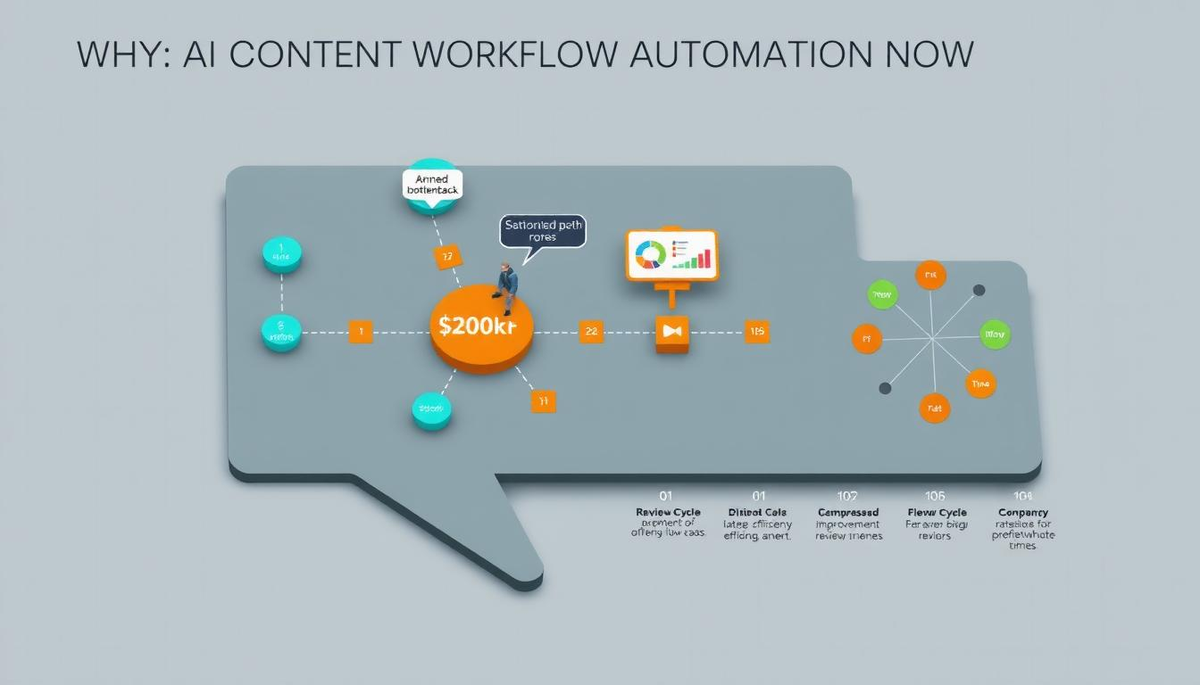
The content landscape has reached a turning point where traditional editorial processes can't match the velocity demands of modern publishing. Building on that urgency, this section explains the operational drivers and pain points automation solves, including capabilities like automated review scheduling and cross-channel content integration.
Publishing teams encounter persistent bottlenecks that throttle growth potential. Manual editing cycles create approval delays as content moves between writers, editors, and channel managers. Context switching between platforms wastes precious time while duplicate efforts across channels multiply inefficiencies.
Scale requirements compound these challenges dramatically. E-commerce teams need product descriptions for thousands of SKUs without expanding headcount. Publishing managers must increase output velocity to meet aggressive content calendars. Meanwhile, quality pressure intensifies as audiences expect consistent brand voice, proper SEO optimization, and factual accuracy at unprecedented speeds.
ai content workflow automation directly addresses these pain points by reducing handoffs between team members and standardizing quality gates automatically. Features like automated review scheduling remove guesswork from refresh cycles, while integrated cross-channel content integration ensures a single source of truth feeds every distribution point. Together, these capabilities let teams move faster without sacrificing control.
Operational drivers and pain points to fix
Publishing teams encounter persistent bottlenecks that throttle growth potential. Manual editing cycles create approval delays as content moves between writers, editors, and channel managers. Context switching between platforms wastes precious time while duplicate efforts across channels multiply inefficiencies.
Scale requirements compound these challenges dramatically. E-commerce teams need product descriptions for thousands of SKUs without expanding headcount. Publishing managers must increase output velocity to meet aggressive content calendars. Meanwhile, quality pressure intensifies as audiences expect consistent brand voice, proper SEO optimization, and factual accuracy at unprecedented speeds.
ai content workflow automation directly addresses these pain points by reducing handoffs between team members and standardizing quality gates automatically.
Economic case and ROI examples
Time savings drive immediate ROI through reduced manual labor. First-pass AI editing typically trims 2-3 hours from each piece, allowing editors to focus on high-value creative work. Batch operations multiply these savings across entire content catalogs.
Cost control improves through hybrid model approaches. Small models handle grammar and copy edits efficiently while larger models tackle complex tone adjustments only when needed. This strategic allocation keeps AI spending reasonable while maximizing impact.
Consider this calculation: saving 0.5 hours per SKU at $40 per hour across 10,000 annual SKUs equals approximately $200,000 in labor savings. Business impact extends beyond cost reduction—better metadata and consistent product content measurably improve click-through rates and conversion percentages.
Risk considerations and how automation addresses them
Hallucination risks receive direct mitigation through RAG grounding systems and human-in-the-loop checkpoints. These safeguards ensure factual accuracy while maintaining production speed that manual processes can't match.
Brand drift concerns disappear with automated style templates and content QA systems. Consistent tone enforcement becomes systematic rather than subjective, eliminating the variability that plagues manual reviews.
Governance improvements include detailed audit logs, model transparency, and role-based approval workflows. Automation standardizes processes, making quality control both measurable and repeatable while providing clear accountability trails for every content decision.
ARCHITECTURE AND ECOSYSTEM CONSIDERATIONS

Building on the compelling economic drivers we've explored—including those substantial $200k annual savings—your technology foundation determines whether AI content workflow automation succeeds or stalls. Teams achieving the most dramatic efficiency gains rely on thoughtfully architected systems that seamlessly integrate AI capabilities with existing content operations while maintaining the quality standards and compliance requirements essential for scaling.
Composable stack for ai content workflow automation
Your foundation requires a headless CMS serving as your single source of truth, connected to workflow engines like Temporal or Camunda for managing approvals and SLA enforcement. AI editing services integrate via REST or GraphQL APIs with idempotent endpoints, ensuring reliable processing even during system interruptions. Event-driven orchestration forms the backbone, using webhooks or message buses to trigger edit jobs, quality assurance checks, and team notifications.
Your DAM and PIM systems feed authoritative product data, while channel adapters transform canonical content for email templates, social media, and marketplace feeds. Observability layers capture detailed logs, performance metrics, and complete content audit trails—essential for maintaining reliability and meeting the compliance requirements we'll explore in upcoming sections.
Human-in-the-loop and automated review scheduling
Policy-driven systems handle recurring reviews—quarterly refreshes for evergreen content, immediate triggers when product specifications change, and seasonal updates aligned with promotional calendars. Smart task assignment routes work by expertise: SEO optimization to specialists, brand-sensitive content to senior editors. Confidence thresholds enable intelligent automation—low-risk grammar corrections proceed automatically, while claims requiring factual verification queue for human review.
Availability-aware assignment prevents bottlenecks by checking team calendars and routing to backup reviewers when primary assignees are unavailable. Version control stores every AI edit as a separate revision, enabling side-by-side comparisons and instant rollbacks when needed.
Data, security, and compliance alignment
Data minimization protocols automatically redact personally identifiable information before external AI processing, with VPC-hosted models handling sensitive content internally. Complete provenance tracking logs model identifiers, prompts, timestamps, and reviewer actions for every AI-assisted change. Role-based access controls enforce approval hierarchies based on content type and risk level—product descriptions might auto-publish after AI editing, while legal claims require multi-tier human approval. This policy matrix foundation prepares your system for comprehensive compliance frameworks, ensuring automation scales safely.
AUTOMATED REVIEW SCHEDULING, TASK ASSIGNMENT, AND QA

Building upon the composable architecture established in the previous section, intelligent automation transforms content operations from reactive firefighting into proactive, policy-driven workflows. The same event-driven orchestration that powers your AI editing services now eliminates coordination bottlenecks while maintaining quality standards at scale.
Automated review scheduling
Policy-driven cadences remove guesswork from content maintenance cycles. Your workflow engine automatically schedules quarterly refresh reviews for evergreen blog posts while triggering immediate review workflows when PIM systems detect product specification or pricing changes. This proactive approach maintains content accuracy without overwhelming editors with unnecessary busywork.
Event triggers create responsive workflows that adapt to business changes in real-time. When your DAM system updates product images or your inventory management platform signals stock changes, the automation immediately flags affected content for AI re-editing and human review. Calendar integration prevents scheduling conflicts by syncing with team availability through Google Calendar or Outlook APIs, sending automated reminders, and implementing escalation paths when deadlines approach.
SLA tracking dashboards provide real-time visibility into workflow health across all content types. Overdue review steps trigger automatic alerts and can reassign tasks to available team members, maintaining consistent throughput even during peak campaign periods. Building on these scheduling capabilities, the next section explores how automation connects content to every publishing channel.
Smart task assignment and approvals
Role-aware routing ensures specialized expertise handles appropriate tasks. SEO optimization edits automatically route to specialists familiar with technical requirements, while brand-sensitive product descriptions flow to senior editors who understand voice guidelines and compliance standards. This intelligent assignment improves both quality outcomes and team efficiency.
Load balancing distributes work based on current capacity and content priority levels. Launch campaigns and seasonal promotions automatically receive priority routing, while routine updates flow to available team members based on workload algorithms. Parallelization splits complex tasks—copy editing, metadata optimization, and localization—allowing simultaneous processing before merging completed work through automated validation checkpoints.
Automated content QA and acceptance criteria
Multi-dimensional QA checks validate content quality across multiple criteria simultaneously. Automated systems assess readability scores, style alignment with brand guidelines, SEO metadata completeness, structured data accuracy, and WCAG accessibility basics before publication approval.
RAG-grounded factuality verification cross-references product claims against your PIM and DAM systems, flagging discrepancies for human audit trails. Clear acceptance thresholds define pass-fail criteria with automatic rollback rules protecting brand standards. Feedback loops capture editor overrides and rejections, feeding this data back to refine AI prompts and model selection, progressively improving automation acceptance rates while preparing for the advanced cross-channel integration strategies we'll explore next.
ADVANCED CROSS-CHANNEL CONTENT INTEGRATION

Building on automated review scheduling and task assignment capabilities, sophisticated content operations require seamless coordination across multiple publishing channels. Modern AI-powered workflows transform how teams manage content distribution, moving beyond isolated channel management to integrated orchestration that maintains consistency while maximizing reach across every customer touchpoint.
Benefits of cross-channel content integration
Cross-channel content integration establishes a single source of truth where canonical content automatically generates variants for web, email, social media, and marketplace platforms. This approach eliminates duplicate work while ensuring unified brand voice and metadata across all touchpoints, reducing the errors and rework that plague fragmented workflows.
Speed becomes your primary competitive advantage as automated transform-and-publish processes reduce turnaround time for multichannel campaigns from days to hours. Teams can launch coordinated campaigns across platforms simultaneously, maintaining message consistency while adapting format requirements for each channel's unique specifications.
Centralized analytics tie AI edits directly to performance metrics like click-through rates and conversion rates by channel, creating feedback loops that improve both AI accuracy and business outcomes over time through data-driven optimization.
Canonical-to-channel orchestration patterns
Channel adapters serve as intelligent translation layers, mapping canonical content fields to platform-specific requirements like Open Graph tags, Twitter Cards, and marketplace-optimized titles. These adapters understand each channel's character limits, image dimensions, and formatting rules, automatically creating compliant variants without manual intervention.
Preview pipelines render channel-specific content before publication, showing responsive email layouts and validating marketplace feed requirements to catch formatting issues early. This prevents publication errors that damage brand credibility and waste editorial time on fixes.
Localization workflows combine machine translation with AI post-editing, applying locale-specific compliance rules per channel. Structured data generation creates JSON-LD and schema.org markup automatically, boosting rich results visibility and marketplace discoverability without manual SEO work.
Version control, rollbacks, and lineage
Immutable versioning preserves complete edit history, distinguishing human modifications from AI contributions for audit trails and machine learning improvement. This lineage tracking enables teams to understand which changes drive performance improvements and refine their automation rules accordingly.
Safe rollback capabilities revert to previously approved content when quality assurance fails or performance metrics decline, protecting brand reputation while maintaining publishing velocity. Content freshness scheduling triggers automated re-edits for outdated items, with A/B testing rotation ensuring continuous optimization.
Integration with brand voice guardrails links directly to style templates, maintaining consistency while enabling channel-specific adaptations that resonate with each platform's unique audience expectations and engagement patterns. These cross-channel patterns naturally feed back into your architecture choices in Section III.
IMPLEMENTATION PLAYBOOK AND BEST PRACTICES (PUBLISHING + E‑COMMERCE)

Building on the cross-channel orchestration patterns we explored, successful AI content workflow automation requires a structured approach that transforms theoretical benefits into measurable business outcomes. Publishing managers and e-commerce teams need practical frameworks that address real operational challenges while maintaining the quality standards your brand voice consistency establishes.
Pilot plan and best practices to implement AI automation
Start with high-impact, low-risk use cases that demonstrate clear ROI. SEO optimization for blog posts and product descriptions for long-tail SKUs offer the best initial testing grounds because they follow predictable patterns while consuming significant editorial time.
Build a minimal viable automation pipeline: CMS webhook triggers AI edit, generates preview for human QA, then publishes upon approval. This simple flow lets you measure time-to-publish reduction and edit acceptance rates without complex infrastructure investments.
Create a policy matrix defining which content types receive auto-publish treatment versus suggest-only recommendations. Product descriptions under $50 might auto-publish, while high-value items require editorial oversight. Technical content always needs factual verification regardless of automation confidence scores.
Train editors on prompt templates, review criteria, and override procedures from day one. Most resistance stems from unclear expectations rather than technology fears.
KPIs, dashboards, and ROI demonstration
Track operational efficiency through time-to-first-draft, overall throughput, backlog age, and SLA compliance metrics. These indicators reveal where automation creates the most significant workflow improvements and identify remaining bottlenecks that need attention.
Monitor quality metrics including AI edit acceptance rates, rollback frequencies, and factual error incidents. A 75% acceptance rate typically indicates well-tuned automation, while higher rollback rates suggest prompt refinement needs.
Measure business impact through CTR improvements, conversion rate changes, and revenue per content item. E-commerce teams often see 15-20% conversion increases from consistent, optimized product descriptions that maintain brand voice while improving searchability.
Build an ROI calculator with inputs for content volume, edit time reduction, hourly editorial costs, and tool expenses including sensitivity analysis showing break-even points under different adoption scenarios.
Procurement checklist and next steps
Evaluate integration capabilities first. Does the solution support headless CMS architectures, RAG for brand-specific knowledge, and connectors for your DAM, PIM, or commerce platform? API-first architectures prevent vendor lock-in and support custom workflows.
Assess governance features including audit trails, data residency options, model transparency, and PII redaction capabilities. Enterprise deployments require these controls for compliance and risk management at scale.
Verify scalability through async job processing, cost controls, model orchestration options, and observability stack integration. Your pilot success means nothing if the solution can't handle production volumes efficiently.
Ready to implement? Download our workflow automation guide for detailed technical specifications and register for our 20-minute implementation webinar to see a real pilot demonstration.
CONCLUSION

Moving from manual coordination to intelligent workflow automation isn't just an operational upgrade—it's your strategic advantage for scaling content operations while maintaining quality control. The evidence speaks clearly: teams implementing AI-driven editing workflows report 50-60% reductions in editorial time, throughput increases of 3-4x, and measurable improvements in brand voice consistency across all channels.
Your path forward starts with focused execution. Begin with high-impact pilots targeting SEO optimization for blog content or product description generation for long-tail SKUs. Instrument your metrics from day one—tracking time savings, acceptance rates, and business outcomes builds the ROI case for broader implementation across your content ecosystem.
Your technical foundation matters. Integrate AI editing with existing CMS infrastructure through headless architectures, implement human-in-the-loop checkpoints for quality assurance, and establish clear governance policies that define auto-publish versus review-required content types.
Ready to transform your content operations? Download our complete workflow automation guide and ROI calculator to map your implementation roadmap. Register for our 20-minute webinar demo to see these integrated systems in action and get technical integration questions answered by our implementation team.
To sum up, AI content workflow automation is the lever that lets teams scale faster, raise quality, and reclaim time for strategic work—start your pilot now and see the difference.